
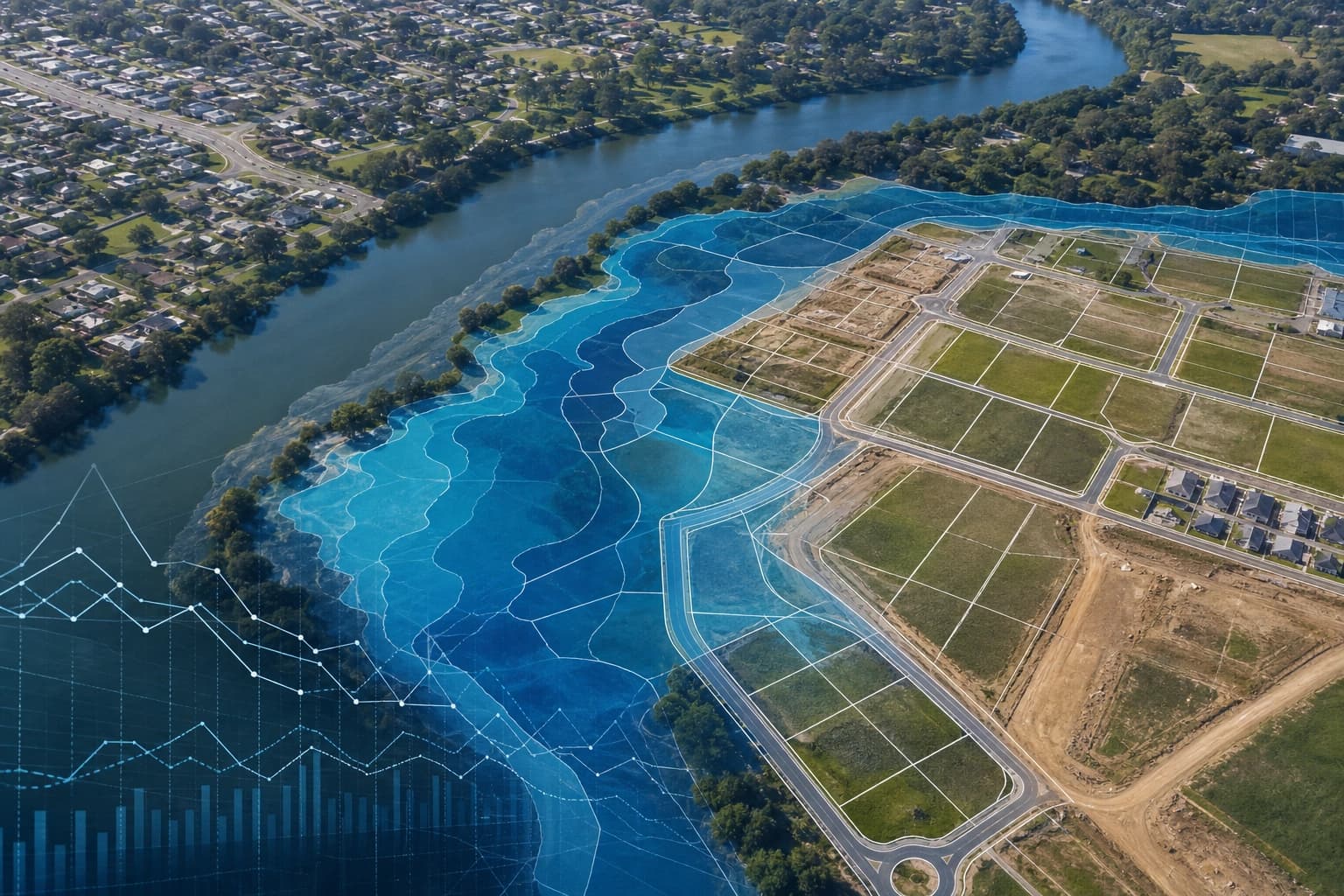
Treating flood risk as only a planning overlay can leave important finance and insurance questions until late in a transaction.
For a developer, a flood flag can affect acquisition price, basement design, civil works, finished floor levels, yield and option conditions. For a buyer's agent, it can become a client-affordability issue if an insurance quote arrives after a pre-auction shortlist has formed. For an investment committee, it can change the risk register from "planning constraint" to "capital, insurance and exit risk".
The better question is no longer, "Is there a flood overlay?" It is: "What do planning controls, flood-study data, insurance signals and climate-risk sources say before we rely on this price or density assumption?"
The risk signal is broader than the overlay
Planning controls remain essential. They tell you whether a site is affected by known flood-related planning provisions, what consent pathways may apply, and which council or state policy settings need attention.
They do not answer every diligence question. A site may need more work because of overland flow, access during a flood event, coastal or estuarine exposure, minimum floor levels, freeboard, stormwater constraints, evacuation, or the age and assumptions behind a flood study. Conversely, a flood-related map hit is not an automatic development blocker. Local policy, survey levels, hydraulic modelling, building design and specialist advice all matter.
The finance and insurance lens changes the timing. If a site is viable only with a tight basement, maximum yield or a low contingency, flood diligence belongs in the pre-acquisition pack rather than after heads of agreement.
Why capital partners and insurers are paying attention
Several public sources explain why flood is now a diligence issue for lenders, insurers and investment committees.
The Department of Climate Change, Energy, the Environment and Water says the 2025 National Climate Risk Assessment is Australia's first nationally comprehensive assessment of climate impacts across systems including infrastructure, the economy and the environment. Its key findings include more frequent and severe floods, fires and cyclones, and 1.5 million more people in high-risk coastal areas by 2050 due to sea-level rise.
The Parliamentary flood insurance inquiry reported that floods accounted for more than 54% of losses from declared insurance events in the previous five years. It also noted that 4.4% of properties nationally are exposed to 1%, 2% or 5% annual exceedance probability flood risk. In its committee comment, the inquiry recommended that governments consider ensuring no further development occurs in areas of 1-in-100 flood risk or greater, with reference to future climate modelling.
The Insurance Council of Australia has said the 2022 eastern seaboard floods generated more than 300,000 claims and over $7 billion in losses. The Actuaries Institute's 2024 home insurance affordability research reported that 15% of Australian households, or 1.61 million households, were affordability-stressed for home insurance, spending more than four weeks of gross household income on premiums.
None of these sources decide the answer for a particular address. They do explain why a short flood note in an investment paper is often no longer enough.
What each role should screen earlier
Different roles need different early questions:
- Developers: does the flood constraint affect yield, basement feasibility, access, fill, detention, floor levels or staging? Could a flood engineer's advice change the acquisition price or option conditions? Capture planning controls, council flood-study references, survey assumptions, AFRIP or council data provenance, consultant scope questions and insurance broker prompts.
- Buyer's agents: could flood affect the client's premium, excess, lending comfort, renovation plans or resale concerns? Should the client obtain an insurer quote before bidding or exchanging? Capture public flood prompts, council certificate or local flood information, insurer quote requests, conveyancer questions and a client note recording referral advice.
- Investment committees: is flood treated as a planning risk only, or also as capex, program, insurance, climate and exit risk? What contingency or condition protects the downside? Capture the risk-register entry, consultant brief, source links, material assumptions, decision record and unresolved questions for lenders or insurers.
For all three groups, the useful output is not a yes/no label. It is a defensible evidence trail showing what was checked, what was still uncertain, and who needs to verify the next step.
Use national flood data carefully
Geoscience Australia's Australian Flood Risk Information Portal is useful because it catalogues flood studies and maps from around Australia. GA describes AFRIP as a catalogue of flood studies completed up to 2018. It is a snapshot and is intended to complement state and territory flood information.
In a transaction, use AFRIP to identify relevant studies, source provenance and historic mapping. Do not treat it as a current address-level flood answer. Pair it with council or state flood information, planning certificates, recent studies, local flood history, survey levels and qualified flood advice where the site warrants it.
NSW provides a useful example of how formal frameworks continue to evolve. The NSW Flood Risk Management Manual was gazetted in June 2023 as the manual relating to development of flood-liable land for section 733 of the Local Government Act, replacing the 2005 manual. Other jurisdictions use their own planning and floodplain-management systems, so a national screen should always lead back to the relevant local pathway.
A practical pre-commitment sequence
Before a site is priced, shortlisted for a client, or sent to an investment committee, run a short sequence:
- Check planning flood controls and certificate prompts for the site and immediate surrounds.
- Identify available flood studies, including study date, source and whether the data is council, state or national catalogue information.
- Note the flood mechanism: riverine flooding, overland flow, coastal inundation, stormwater, dam release or a combination.
- Test the development assumptions most exposed to flood advice: basement, ground-floor use, fill, finished floor levels, emergency access, electrical services, car parking and civil works.
- Ask insurance questions early: can a quote be obtained, what information will the insurer need, and would flood cover materially affect affordability or holding costs?
- Record unresolved items for the flood engineer, planner, conveyancer, insurer, lender or legal adviser.
Good flood diligence is as much about briefing as mapping. A consultant can give better advice when the brief includes source links, relevant overlays, nearby studies, concept assumptions, proposed use, survey information and the commercial decision being made.
Where Enviro-D fits
Enviro-D helps property teams run an early flood diligence screen before time and capital are committed. It can bring planning flood overlays, available flood-study context, source notes and climate-risk prompts into a single evidence layer for candidate sites.
Use it to flag issues, brief specialists and document the questions in an investment committee pack or client-ready note. It does not replace council certificates, flood engineers, insurance quotes, lender review, legal advice or formal approvals.
If a site depends on flood-sensitive assumptions, screen it early with Enviro-D, then use the evidence trail to ask sharper questions of the right specialist before the deal becomes hard to unwind.
Sources and further reading
- DCCEEW: National Climate Risk Assessment
- Geoscience Australia: Australian Flood Risk Information Portal
- NSW Flood Risk Management Manual
- Parliament of Australia: Flood insurance inquiry, Chapter 9
- Insurance Council of Australia: response to flood insurance inquiry recommendations
- Actuaries Institute: Home Insurance Affordability and Home Loans at Risk