
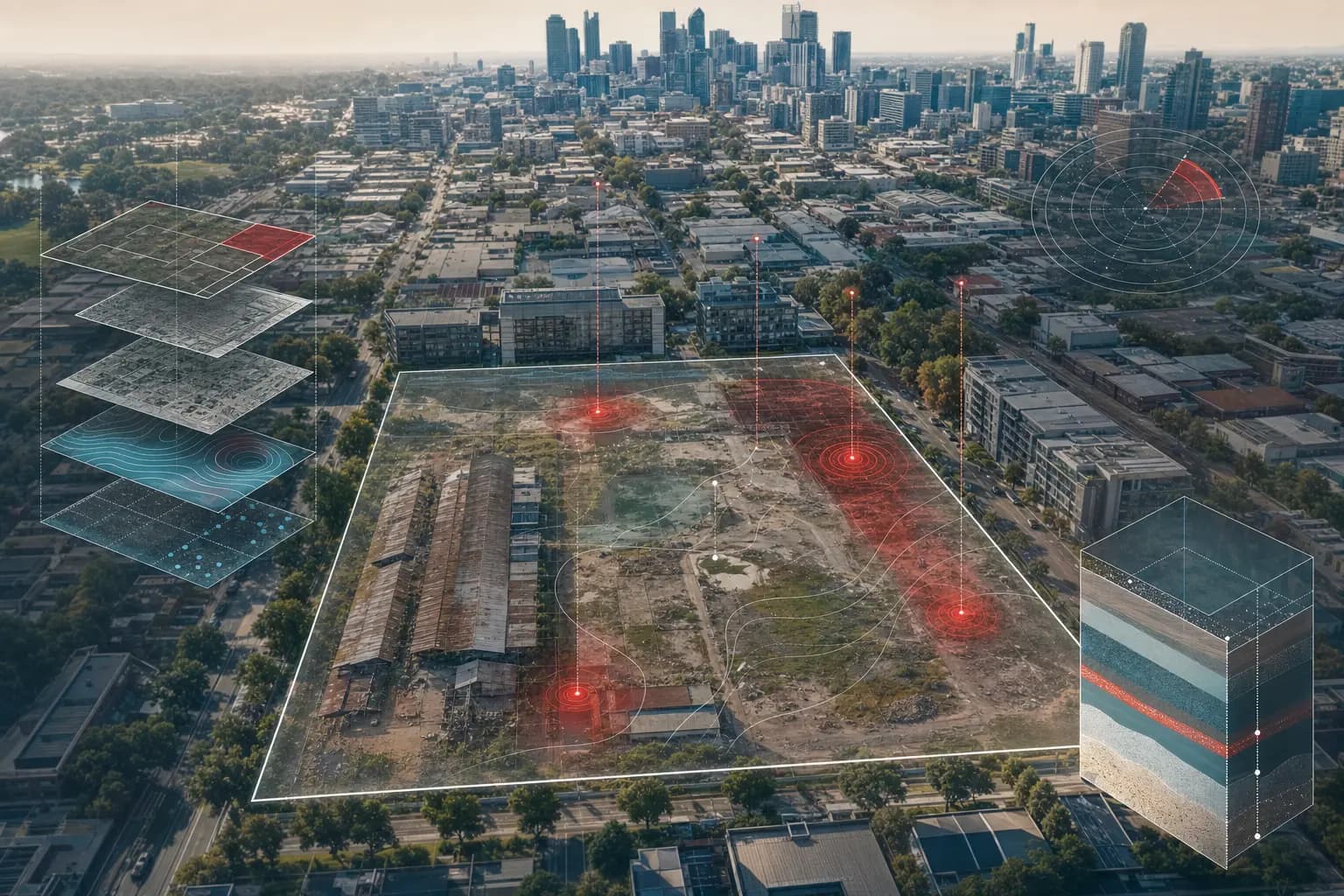
Acquisition teams do not need a full contamination investigation for every site on the longlist. They do need a disciplined way to decide when contamination is material enough to affect price, option terms, consultant scopes, finance conversations or the investment committee pack.
That decision is getting harder on infill and transport-oriented sites. Housing pressure is pushing feasibility work into former industrial strips, service-station corners, rail-adjacent land and mixed-use corridors, while contaminated-land planning pathways remain state-specific. A database search is a useful start, but it should not be treated as a clearance certificate.
The trigger question: when should a desktop screen become a PSI, PRSA, audit pathway check or specialist consultant brief?
What a PSI is in transaction terms
Planning Victoria's PPN30 on potentially contaminated land points to the National Environment Protection (Assessment of Site Contamination) Measure: a PSI is the first stage of assessment, primarily desktop-based, used to establish site history and develop a conceptual site model. In deal terms, it is where a quick screen becomes a documented consultant assessment that can recommend whether further investigation is needed.
A PSI is not a guarantee that land is clean. It may identify data gaps, recommend sampling, flag vapour or groundwater pathways, or support a low-risk conclusion for the proposed use. If your template uses "Phase 1 ESA Australia" language, align it to the relevant PSI, PRSA and audit pathway.
Triggers for moving beyond a simple screen
1. Historic use is unclear or points to contaminating activity
A former service station, workshop, dry cleaner, factory, fuel depot, waste-handling site, rail-adjacent parcel or filled land does not automatically stop a deal. It does mean the team should avoid relying on agent history, current zoning or a clean-looking inspection.
Trigger a PSI where past use could affect the proposed development, especially residential, mixed-use, childcare, aged care, basement excavation or substantial soil movement. The aim is to establish site history early enough to adjust price, request vendor information, condition the option or brief sampling before design assumptions harden.
2. A register hit appears on or near the site
Government registers and notified-site lists are important, but they have limits. NSW EPA says its notified and regulated contaminated land list is "indicative only and a starting point" for a buyer's own assessment. Land may also be regulated under the Contaminated Land Management Act if it is declared significantly contaminated.
Queensland's Environmental Management Register and Contaminated Land Register searches are commonly used by people buying, developing or changing land use, but the register page cautions that searches may not reveal unnotified contamination or unnotified notifiable activities.
A register hit should trigger more than a screenshot in the data room. Ask whether the listed site is the subject land, adjoining land or upstream/upgradient land; whether there is a plausible soil, groundwater, vapour or drainage pathway; and whether the proposed use increases sensitivity. If yes, move to a PSI or specialist advice before the bid becomes unconditional.
3. No register hit, but evidence is thin
No public register result is not the same as no contamination. Registers depend on notification, thresholds, parcel history and search mechanics. For recently reconfigured lots, Queensland's page notes a parcel-search issue, so verify how the search was run.
If the feasibility case assumes no remediation allowance, delay, soil classification issue or planning condition, a "no hit" may be carrying too much weight. Use a PSI where the downside would be material to land value or program.
4. The planning pathway requires contamination to be considered
Planning triggers are often the strongest reason to act before exchange. In NSW, contaminated land planning controls now sit in Chapter 4 of the State Environmental Planning Policy (Resilience and Hazards) 2021, and Ministerial Direction 4.4 requires consideration of contamination for rezonings.
In South Australia, the planning system must assess known or potential site contamination. PlanSA's site contamination assessment guidance notes October 2025 changes, including a reduced land-use sensitivity hierarchy and PSIs being valid for five years.
If your strategy depends on rezoning, subdivision, uplift, sensitive use or a clean path through DA conditions, consider a PSI before committing to yield, program or option exercise dates.
5. A Victorian PRSA or audit issue could be in play
Victoria needs special attention because the PRSA pathway can be central to planning decisions. EPA Victoria says a Preliminary Risk Screen Assessment can support planning decisions, is often needed for new developments and subdivisions, and only an EPA-appointed environmental auditor can prepare the PRSA statement and report.
For acquisitions, ask whether site history, proposed use and planning pathway could require an auditor process, PRSA statement, environmental audit or further assessment. If that could affect settlement timing, finance or vendor obligations, record it before signing.
6. Excavation, dewatering, fill or vapour could affect delivery
Contamination becomes a delivery issue when it intersects with the construction method. Basements, piling, dewatering, services trenches, bulk excavation, imported fill, unexpected stockpiles or reuse of site-won material can change cost and approval risk. Vapour and groundwater pathways can also matter near former fuel, solvent or industrial uses.
A desktop screen should ask delivery questions too. Will civil works disturb unknown fill? Will groundwater be encountered? Could a nearby source create vapour concerns? Would unexpected contamination change the construction budget or critical path?
What to put in the IC pack
A useful contamination trigger pack should be concise for the deal team and detailed enough for the consultant brief:
Capture five things:
- Current and historic land-use indicators so the team can see whether site history justifies a PSI or vendor data request.
- Register, notice and planning-source links, with search dates so the pack has an auditable record rather than a loose screenshot.
- Proposed use and sensitivity changes so contamination prompts are tied to the development strategy.
- Nearby sites, drainage, groundwater and vapour prompts so off-site source questions can be scoped.
- Recommended next step so the deal team can distinguish "monitor", "PSI now", "PRSA/audit advice" and "condition the option" decisions.
The best output is a clear recommendation: proceed with documented low-risk assumptions, obtain a PSI before exchange, require vendor disclosure, include an option condition, or brief an auditor or consultant before IC approval.
How Enviro-D helps with early triage
Enviro-D can help assemble a pre-acquisition contamination trigger pack by screening historic land-use indicators, nearby registers and notices, groundwater or vapour prompts, planning overlays and jurisdiction-specific source links. Acquisition teams can decide which sites need specialist follow-up before design and funding assumptions are locked.
Enviro-D does not certify land, clear contamination risk, replace a PSI, prepare a PRSA, replace an environmental audit or provide legal advice. It screens, flags, documents and helps brief the right specialists earlier.